Farriery for the veteran horse
By ANDREW POYNTON FWC

By ANDREW POYNTON FWC
As horses age so their physique gradually changes. Muscle suppleness becomes diminished, it takes longer to warm up and loosen. Arthritis may affect some joints, collateral ligaments tighten, the suspensory apparatus of the limbs – the suspensory ligament and the flexor tendons, have often suffered injury and this together with reduced muscle from natural wastage means there is less to support the horse and it is more prone to ‘breaking down’.
An old horse may, for example, stand with the fore limbs tucked under, over at the knee and the hoof pastern axis alignment broken forward, the pastern at a low angle and the fetlock sitting low – obvious signs of suspensory demise.
If this horse has not already come to the end of his working life, starting with the front limbs, shoes with a shortened breakover would be appropriate whether a dub toed shoe or ground rolled, there are a number of brand named shoes that achieve this end.
They reduce the effect in taking a stride and reduce the likelihood of stumbling. The broken back HPA upright pastern would benefit from a graduated shoe, thinner at the toe rather than raising the heel height.
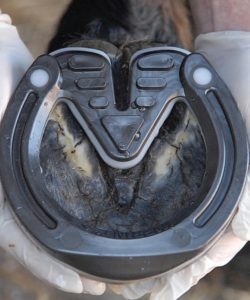
The shoe would best be a bar shoe, a heart bar for maximum surface area and heel support – this provides elevation for the foot on soft surfaces.
It relieves the heels of so much loading, so a square/dubbed toe graduated heart bar shoe meets the requirement.
Some farriers will favour filling the back half of the foot with some form of elastomer or silicon filler to achieve the same end, or in conjunction with a regular heart bar shoe.
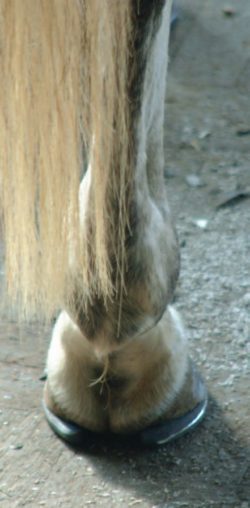
These synthetic and plastic materials can be used effectively to create cushioning and enhance the area of the foot. A flexible plastic heart bar can again often achieve surprisingly good results.
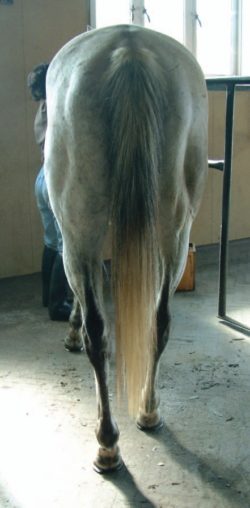
The limb with a low fetlock would not benefit from any form of raising the heel, but be shod similarly with a flat heart bar shoe fitted with fullness in the heel quarters and right to the bulbs of the heels – definitely not short.
Studs are not advised, but if the horse is prone to slipping on the road then to avoid falling, a pair of tungsten pins or nails can be fitted in the back half of the shoes, one in each side; they stand proud by about 2mm or 1/8” and give traction, but increase the jarring on the foot/limb.
Addressing the hind limbs – the traditional shoe in the UK for spavin has a set toe, a strong turned up toe set into the toe of the hoof with wedged up heels; this shoe is only really effective on a hard surface.
As many horses now spend much time on arenas, shoeing appropriate to this type of surface seems sensible.
I prefer and find effective a broad webbed shoe, quarter clipped set well under the toe, with a lateral extension. This shoe wears well and gives more stability to the limb.
It again must not be fitted short, but with some extra length providing floatation to the back of the foot, it will not sink into the surface so much, therefore relieving the hock of excessive strain.
The horses need a sympathetic and patient farrier; they object to being pulled around. Intolerance to uneven ground could indicate arthritic joints, ringbone, medio lateral imbalance or sidebone to mention just some possibilities.
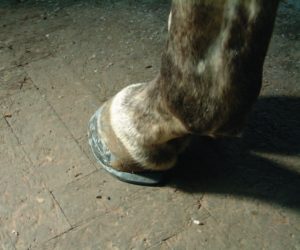
The experienced farrier in addition to working with the vet, utilising any radiographic or other evidence, will notice the horse’s stance, watch the horse move, will notice any unevenness of footfall, tripping, lack of flexion and lameness if present.
The wear of the hoof or shoe if shod is invaluable evidence in determining peculiarities of the gait of the horse.
The shape and quality of feet will be noted, and their relationship to the horse’s conformation. Once aware of the evidence an appropriate treatment can be formulated.
The type of shoe and fit will aim to encourage an as fluent as possible stride, level foot fall, or, if not possible, a roll into landing and a central base of support below the limb, when moving through the weight-bearing phase of the stride.
So, easing the stride and cushioning the impact sums up much of what can be done. Other than wear and tear on the veteran horse’s feet, the metabolic changes in some horses sadly induce laminitis which is a subject on its own.
Provided the above points are routinely addressed, both the horse and farrier should grow old gracefully together.
It is up to the owner to provide a suitable environment in which the horse can thrive and have realistic expectations of both the horse and farrier.
I know a number of horses in their thirties, but still enjoying quality of life, even one or two ponies over forty, one still a leading rein pony.
The areas on which to concentrate to enable the older horse to remain active in relative soundness are:
This article first appeared in Horse Health Magazine, December 2009/ January 2010 Copyright © Andrew Poynton