Challenge of Maintaining the TB Foot
By ANDREW POYNTON FWCF

By ANDREW POYNTON FWCF
THROUGHOUT the development from foal to racehorse, mediocrity in the farriery department will not do if the horse’s potential is to be realised. By the time a horse goes into training as a two year old for the flat, it is likely to have already been plated for the yearling sales, however, the feet are far from maturity and all structures still developing and growing.
At this stage maintaining balance that is central beneath the bone column landing and loading evenly, and well trimmed hooves, continue to be essential if the horse is to have the best chance of staying sound in work as a mature horse.
As soon as a colt or filly is plated it is only too easy to fit the heels of the plate tight, to prevent shoe loss; but very quickly as the hoof grows the heels run under and flatten.
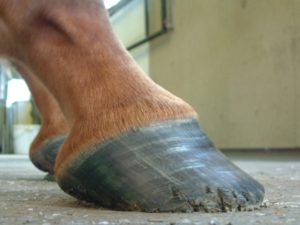
The heel of the shoe overloads the seat of corn area and the horse gets corns or ‘heel pain’. The inside heels usually crush more due to being closer to the central body mass. Wet conditions under foot contribute to softening of the horn structures and bacterial degradation; this problem is less likely in arid environments such as Dubai or Australia where the TB hoof can be tighter deeper and stronger.
That said, not all race horses in the UK have poor hooves, far from it, but we do have our fair share.
Once the proportions of the hoof become distorted, the balance is thrown out. A common sight is a flat foot with a low hoof angle and the hoof pastern alignment broken back, which has succumbed to the effects of the environment, work and shoeing regime, and hoof type.
The shallow hoof can only withstand so much before collapsing, whereas the dry stronger more upright hoof will hold out for longer. In an attempt to prevent the toes spreading some well meaning farriers may over trim the front wall hard back to the white line, thinning the hoof wall which initially may appear aesthetically improved, but in effect weakens the strongest part of an already weak hoof. This combined with fitting heels short and tight, is a recipe for, if not disaster, a lame horse.
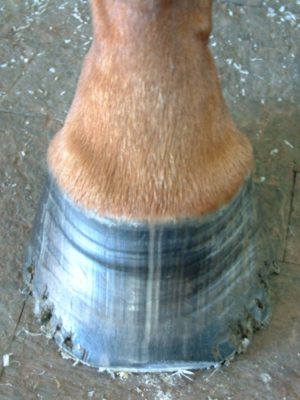
Add six or eight closely driven nails into an already frequently nailed hoof and you do have a disaster. A horse with flat feet, most likely bruised soles, sore heels and split hoof walls is unable to take a nail. The lightweight plates, particularly if partially worn out and not clipped, can twist – pulling at the nails in the horn.
It is a hard job to enable a hoof in this state to recover and time consuming, if at all possible – these are high maintenance feet, needing more frequent attention. When shoeing and plating racehorses it is important to preserve and nurture a healthy hoof, but it can be, and is, done, by some excellent craftsmen.
The margins for error are fine, shoeing by feel rather than sight. Depending on the particular yard regime some racehorses are shod with light steel for work and training and plated for the track when running; this obviously creates more shoeing thus more nail holes in the hooves, but shrewd farriers will be careful to re-use good old nail holes and keep nails to a minimum to securely hold the shoe.
Injuries such as overreaching, brushing and scalping are mostly resolved by paying attention to the basic principles of shoeing – taking time to watch the horse moving to identify any peculiarities of gait.
To summarise, the feet should be trimmed regularly to maintain correct length balanced hooves, with a correct hoof pastern axis. Shoes should follow the outline of the hoof and fit right to the bulbs of the heels with no sharp protrusions.
I prefer the hind shoes to be set under the toe and the toe rounded at the base to prevent injury or interference from overreaching; though many trainers and farriers plate with a toe clip on the hinds to help prevent the shoe from spreading and being kicked back.
Hoof cracks encountered in brood mares and young stock are predominantly due to overgrowth with a few exceptions, injury or conformational peculiarity. In horses in training this could also be the case, but neglect or poor farriery aside, due to the extreme pounding the feet take quarter cracks are not uncommon. It is seen more in two and three year olds with immature hooves. At the point of maximum expansion the shod hoof cannot expand quickly enough and bursts out splitting from the coronary border. It will bleed and shear completely if not dealt with immediately and there are a number of farriery remedies for this.
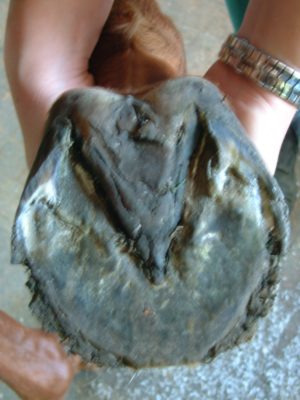
Current procedures include acrylic patching and re-enforcing with fibre glass, self tapping screws and wire; also there are a variety of crack plates available to glue on. These combinations are used firstly for the adhesive grab, and secondly for tensile strength of the reinforcement material. Yet another method is a plastic and adhesive mix – the plastic which has similar strength to the horn is moulded and keyed into the hoof with the adhesive. A carbon fibre quarter patch has also been developed at the Royal Veterinary College to re-enforce the hoof quarters as a precaution but not as a repair product.
When hooves have been damaged by nailing, degraded from bacteria or other reason, there are a selection of hoof care products available that in the right hands can rebuild and restore hooves, however, a prophylactic approach is more desirable.
Horses’ hooves appear to thrive best in dry and clean bedding, where the air can circulate around the feet, and preferably on rubber matting; fine wood shavings pack in the sole harbouring bacteria. In a yard where the horses are walked in sea water the hooves are clean and strong and I am sure this is a great benefit. The areas that influence hoof quality most are farriery and environment; if the horse has a balanced diet and good coat then usually the horn quality is also good. Hoof supplements and dressings are no substitute for the former.
The quality and health of the feet have a major effect on the horses’ performance, and so worth giving the best possible care.
This article first appeared in Horse Health Magazine, August/ September 2009 Copyright © Andrew Poynton